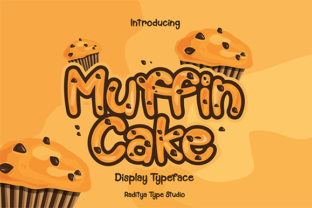
Muffin Cake: A Sweet and Charming Handwritten Font Full of Love
Muffin Cake isn’t just another decorative typeface—it’s a deliberate, expressive tool designed to infuse warmth, personality, and sincerity into digital and print communication. As a sweet and charming handwritten font, Muffin Cake carries the gentle imperfection of human touch: soft curves, subtle variations in stroke weight, and a natural rhythm that evokes handwritten notes, recipe cards, or heartfelt letters. It doesn’t shout—it invites. And for professionals who value authenticity alongside clarity, that quiet resonance matters.
Where Muffin Cake Fits in Your Creative and Communication Workflow
Fonts are rarely chosen in isolation—they’re selected as part of a broader process: defining tone, reinforcing brand voice, guiding user attention, or supporting emotional intent. Muffin Cake enters that process at the intersection of intention and execution. It’s most effective when the goal is to soften formality without sacrificing legibility—think invitations, packaging copy, social media graphics, educational handouts, or personal branding assets. Unlike highly stylized scripts that sacrifice readability at small sizes, Muffin Cake maintains strong character recognition even at 14–16px, making it viable for body text in carefully controlled contexts like email headers, blog callouts, or illustrated guides.
It works especially well in workflows where consistency and emotional alignment must coexist—like launching a small-batch bakery’s website, designing a mindfulness course workbook, or building a teacher’s classroom resource library. In each case, the font isn’t just decoration; it’s part of the delivery system for trust, care, and approachability.
Using Muffin Cake Before, During, and After a Project
Before a project: Muffin Cake can shape early decisions—not just about typography, but about positioning. If you’re drafting a brand voice guide for a new wellness app, testing headlines in Muffin Cake helps surface whether “gentle,” “nurturing,” or “playful” truly fits your audience’s expectations. Its presence in mood boards or style tiles signals intention before a single line of code is written.
During execution: Integration is straightforward. Muffin Cake supports standard OpenType features (ligatures, stylistic alternates) and is available in web-friendly formats (WOFF2) and desktop-ready OTF/TTF files. For designers using Figma or Adobe Creative Cloud, it installs cleanly and pairs predictably with neutral sans-serifs like Inter, Lato, or Montserrat—creating balanced hierarchy without visual competition. Developers embedding it via Google Fonts or self-hosting benefit from its modest file size (~80 KB for full character set), minimizing load-time impact.
After launch: Its role shifts toward reinforcement and refinement. You might audit how Muffin Cake performs across devices—does it render crisply on iOS Safari? Does it hold up in printed PDFs shared with educators? These aren’t afterthoughts; they’re quality-control checkpoints. Over time, usage patterns emerge: perhaps it becomes your go-to for “thank you” banners, subscriber welcome emails, or seasonal campaign accents. That repetition builds recognition—not just of the font, but of the feeling it consistently delivers.
Practical Integration Tips for Real Workflows
Here’s how to bring Muffin Cake into daily use without friction:
- Pair intentionally, not ornamentally. Use it for short, high-impact text—headlines, pull quotes, CTA buttons—not long paragraphs. Let a clean sans-serif carry body copy while Muffin Cake adds warmth to key moments.
- Test contrast rigorously. Its light weight demands careful background choices. Avoid pale yellow on cream or pastel pink on white. Dark charcoal on off-white or deep navy on ivory yields reliable readability.
- Leverage OpenType features selectively. Enable standard ligatures for natural flow in words like “offering” or “beautiful.” But disable discretionary ligatures in all-caps settings—they disrupt spacing and reduce scannability.
- Standardize usage across tools. Create a Figma text style called “Muffin Cake – Headline (H2)” with fixed size, letter-spacing, and color. In Notion or Airtable, document when and where it applies—so contractors or team members apply it consistently.
- Preserve accessibility. Never rely solely on Muffin Cake to convey meaning. Pair it with sufficient color contrast (at least 4.5:1), and always provide alt text for image-based uses (e.g., social graphics). Screen readers won’t interpret font choice—but users will feel its effect.
Compatibility and Long-Term Usability Considerations
Muffin Cake integrates smoothly with common platforms—Canva, Squarespace, Webflow, Shopify—but check rendering behavior in each. Canva applies automatic anti-aliasing that sometimes blurs its delicate strokes; manually adjusting text rendering to “sharp” or “crisp” often restores clarity. On Shopify, uploading the WOFF2 directly (rather than relying on theme font managers) gives more control over fallbacks and loading strategy.
For long-term use, consider versioning. If you adopt Muffin Cake for client work, archive the exact font file used—and note its OpenType version—in your project assets folder. Minor updates can shift glyph metrics or spacing, affecting layout integrity months later. Also, keep a lightweight fallback stack documented: "Muffin Cake", "Comic Neue", cursive ensures graceful degradation without visual whiplash.
Real-World Implementation Examples
A freelance educator created printable reflection journals for middle school students. She used Muffin Cake for section titles (“What Made You Smile Today?”) and hand-drawn-style prompts, then paired it with Nunito for instructions. The result felt inviting—not childish, not clinical. Teachers reported higher student engagement with the physical worksheets, and the font became a subtle throughline across her digital course materials.
A local candlemaker redesigned her product labels with Muffin Cake for scent names (“Honey & Lavender,” “Storm Window”) and a minimalist serif for ingredients and safety info. The contrast reinforced artisanal credibility while keeping regulatory text fully legible. Inventory turnover increased 18% in the first quarter post-redesign—customers cited “the warmth of the packaging” in reviews.
A productivity coach built a habit-tracking Notion template using Muffin Cake for weekly affirmation headers (“You’re showing up,” “Progress > perfection”). Because Notion doesn’t support custom fonts natively, she embedded them as lightweight SVG headers—ensuring consistency without compromising performance. Users noted the subtle uplift in motivation, attributing it partly to the “human-feeling” typography.
Why Consistency Matters More Than Frequency
You don’t need to use Muffin Cake on every page or in every email. What builds recognition—and reinforces its emotional value—is consistent application in consistent contexts. When someone sees Muffin Cake, they should know, almost unconsciously: this is where care is centered. This is where invitation lives. This is where the human voice comes through.
That requires intentionality—not just in selection, but in maintenance. Audit your usage every few months. Ask: Is it still serving the purpose it was chosen for? Has our audience evolved? Does it still align with our broader visual language? Tools change. Platforms update. But the reason you chose Muffin Cake—its sweet and charming handwritten quality, full of love—doesn’t need to.
When integrated thoughtfully, Muffin Cake becomes more than a font. It becomes a quiet collaborator in your process: helping you plan with empathy, execute with clarity, and deliver with warmth—without ever drawing attention to itself.