Zombie Carshel: The Handwritten Font That Bleeds Authentic Halloween Energy
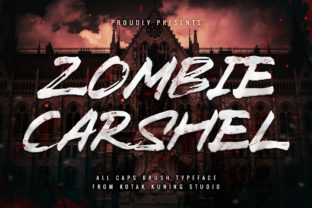
If you’ve ever stared at a design mockup—whether it’s a spooky event flyer, a limited-edition merch label, or even a classroom poster about Edgar Allan Poe—and thought, “This needs more grit,” then Zombie Carshel is probably already whispering your name. It’s not just another Halloween font. It’s an all-caps, dry-brush handwritten typeface with visible texture, uneven pressure, and that unmistakable “just-escaped-the-graveyard” rawness. No smooth curves. No polished kerning. Just character—with a side of decay.
Where This Font Lives (and Thrives)
Zombie Carshel doesn’t belong in corporate board decks or legal disclaimers. It belongs where atmosphere matters more than alignment: on hand-painted signs outside haunted houses, on vinyl sticker packs for indie zines, on Instagram story graphics teasing a new horror podcast season, or even scribbled across the cover of a self-published novella about cursed carnival rides. Its strength isn’t versatility—it’s intentionality. You choose Zombie Carshel when you want people to feel the texture before they read the word.
Think about a small-batch candle maker launching a “Midnight Cemetery” scent. Swapping their usual serif logo font for Zombie Carshel on the front label doesn’t just say “Halloween”—it says, “This candle wasn’t mass-produced. It was conjured.” Same goes for a high school drama teacher designing posters for The Crucible: using Zombie Carshel for the title adds unease without needing extra imagery. The font itself becomes part of the storytelling.
Real People, Real Uses—No Guesswork Needed
Freelance designers reach for Zombie Carshel when clients ask for “something handmade but scary” — especially for packaging, apparel, or social assets tied to October campaigns. One designer told us she used it for a local brewery’s “Ghoul Stout” can series; the dry-brush effect mimicked ink bleeding through recycled paper stock, making the digital file feel tactile before it even printed.
Educators use it sparingly—but effectively—for thematic units. A middle school ELA teacher overlays Zombie Carshel on a digital “Witch Trial Wanted” poster during her Macbeth unit. Students don’t just memorize motifs—they feel the paranoia. It’s not about gimmicks; it’s about lowering the barrier between text and mood.
Bloggers and content creators lean into Zombie Carshel for seasonal email headers (“Your October Reading List Is Haunted”), YouTube thumbnails (“5 REAL Places That Inspired Horror Movies”), or Patreon banners announcing bonus lore drops. Because let’s be honest: if your thumbnail looks like every other creator’s clean sans-serif grid, it won’t stop the scroll—even if your content is gold.
And for small business owners, especially those in niche markets (vintage toy restoration, occult bookshops, immersive escape rooms), Zombie Carshel helps signal identity fast. It tells customers, “We’re not trying to blend in—we’re leaning into the weird, and we know you do too.”
What to Consider Before You Drop It Into Your Project
Zombie Carshel is expressive—but it’s not neutral. That’s its superpower and its limitation. Before downloading or licensing it, ask yourself:
- Is legibility still priority #1? At small sizes (<14px) or in long paragraphs, the dry-brush texture can blur letterforms. Save it for headlines, logos, short quotes, or decorative accents—not body copy.
- Does this match your brand voice long-term? If you’re a wellness coach launching a “Spooky Self-Care” October challenge, Zombie Carshel might land as ironic fun. But if your brand voice is consistently warm and grounded, one-off Halloween usage is fine—just don’t try to force it into your permanent logo.
- How will it render across devices? Some dry-brush fonts lose texture on low-res screens or certain email clients. Always test in context—not just in your design app, but on mobile, in Gmail previews, and as a live web banner.
- Is licensing clear for your use? Zombie Carshel is often offered under personal or commercial licenses. If you’re using it on client work (e.g., designing a festival poster for a city arts council), double-check whether your license covers third-party usage—or if you need an extended version.
Why “Rough” Isn’t Just Aesthetic—It’s Strategic
In a world saturated with hyper-polished templates and AI-generated visuals, roughness reads as human. Zombie Carshel’s uneven strokes, slight wobbles, and visible brush drag aren’t flaws—they’re proof of hand, time, and intention. That translates directly to perceived authenticity. A food blogger using it for a “Witchy Brunch Board” graphic signals playfulness and craft—not perfection. A game developer naming a boss “THE HOLLOW WARDEN” in Zombie Carshel immediately telegraphs tone before a single pixel of art loads.
It also works surprisingly well in contrast. Pair it with a clean, geometric sans-serif (like Montserrat or Inter) for body text, and you get hierarchy with personality: the headline grabs, the details inform. Or layer it over grainy film textures or parchment scans—suddenly you’re not just designing a poster, you’re building a world.
Not Every Project Needs a Zombie—But Some Desperately Do
You won’t use Zombie Carshel for your tax prep service’s homepage. You won’t use it on safety signage at a children’s museum. And you probably shouldn’t use it for your wedding invitation unless “goth garden party” is the entire vibe. But when the moment calls for visceral impact—when “spooky,” “raw,” “handmade,” or “unsettling” are actual goals, not just keywords—Zombie Carshel delivers something no algorithmic font generator can replicate: humanity, with fangs.
So next time you’re stuck choosing a font that *means* something—not just fills space—ask yourself: does this need polish? Or does it need pulse?
Zombie Carshel won’t fix weak copy or unclear messaging. But in the right hands, at the right time, it turns “here’s an event” into “you’ve been summoned.” And sometimes, that’s exactly what your audience came looking for.