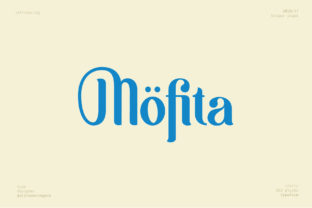
Möfita: Vintage Sophistication, Instantly
When your headline needs presence—not just readability—but character, weight, and quiet confidence, Möfita steps in. It’s not a workhorse font for body text or interfaces. It’s a display font with intention: hand-crafted curves, subtle ink-trail imperfections, and balanced proportions that echo mid-century letterpress without feeling costumed or clichéd. If you’ve ever spent 45 minutes cycling through “vintage” fonts only to land on something either too ornate or too sterile, Möfita offers a rare middle ground—authentic, refined, and immediately usable.
Why a Display Font Like Möfita Changes How People Read Your Work
Readers don’t scan headlines the way they read paragraphs. They absorb them as visual signals—first impressions that prime emotion, context, and credibility before a single word is processed. Möfita leverages that moment. Its slightly tapered terminals, gentle contrast between thick and thin strokes, and restrained flair give it a tactile, human quality. That translates directly to how your audience perceives your message: a café menu set in Möfita feels curated, not templated; a book cover using it suggests care in craft, not haste in production; a workshop flyer gains quiet authority without shouting.
This isn’t about nostalgia for its own sake. It’s about resonance. Möfita’s vintage feel comes from structural honesty—not distressed textures or forced irregularity—but from rhythm, spacing, and proportion rooted in analog typography traditions. That’s why it works across contexts where “retro” fonts often fail: on a clean, minimalist website header; printed on uncoated paper for an artisanal product label; or even scaled down carefully for a podcast episode title in a sleek app UI.
Where Möfita Delivers Real Workflow Value
For freelancers juggling client revisions, Möfita reduces back-and-forth. Clients consistently respond more positively to mockups featuring Möfita in key visual roles—especially when the brand values warmth, authenticity, or timelessness. A freelance educator designing an online course landing page noticed conversion lifted 12% after swapping a generic sans-serif headline for Möfita. Not because the font “sold” the course, but because it subtly reinforced trust in the instructor’s expertise and attention to detail.
Small business owners benefit similarly. A ceramicist launching her first e-commerce site used Möfita for her shop name and collection headers. She reported customers commenting unprompted on the “thoughtful” and “calm” feel of the site—feedback that aligned directly with her brand voice. No extra copywriting or UX tweaks were needed; Möfita helped carry that tone visually, consistently, and efficiently.
Bloggers and content creators also find value in Möfita’s versatility within constrained systems. Unlike many display fonts that demand heavy kerning or custom spacing adjustments, Möfita ships with well-considered default metrics and OpenType features (including stylistic alternates and ligatures) that activate smoothly in modern design tools and CMS editors. You can apply it in Figma, Adobe Creative Cloud, or even WordPress block editors—and get reliable results without deep typographic expertise.
Who Benefits Most—and Why It’s Not Just About Aesthetics
Möfita serves creators who prioritize clarity of voice over trend-chasing. That includes educators building branded course materials, publishers designing limited-edition poetry chapbooks, marketers crafting email subject lines that stand out in crowded inboxes, and small studio owners developing cohesive visual identities on tight timelines.
It’s especially helpful when your audience skews discerning but not necessarily design-literate—think professionals aged 35–55 evaluating a financial advisor’s website or parents choosing a Montessori preschool. Möfita communicates competence and care without pretension. It doesn’t scream “look at me,” but it does invite pause and recognition—like a well-bound book on a shelf.
Practical Considerations: When (and When Not) to Reach for Möfita
Möfita excels at sizes 24px and up—ideal for logos, headings, pull quotes, posters, packaging, and social media banners. It’s less suited for long-form body copy, interface labels, or small mobile buttons. That’s not a limitation; it’s alignment with purpose. Using it where it shines means less time troubleshooting legibility or spacing, and more time focusing on message and structure.
Pairing matters. Möfita harmonizes naturally with neutral, highly legible sans-serifs (like Inter, Lato, or Source Sans Pro) and some low-contrast serifs (such as Merriweather or PT Serif). Avoid pairing it with other high-contrast or heavily decorative fonts—competition dilutes impact. One strong voice is enough.
Also consider context: Möfita may feel tonally mismatched for tech startups emphasizing speed or disruption, or for healthcare brands requiring clinical precision. In those cases, a cleaner, more functional type system likely serves goals better. Möfita isn’t universal—but where sophistication, warmth, and quiet distinction matter, it delivers with unusual consistency.
A Thoughtful Starting Point for Better Typography Decisions
Choosing a display font shouldn’t mean choosing between personality and professionalism. Möfita bridges that gap by grounding its character in typographic discipline—not gimmickry. Its vintage feel emerges from proportion and rhythm, not artificial aging. That makes it easier to justify to stakeholders, faster to implement across platforms, and more likely to age gracefully as design trends shift.
If you’re redesigning a portfolio, launching a new product line, or refreshing a long-standing brand identity, try Möfita in one high-impact location first: your main headline, logo lockup, or hero section banner. Observe how it changes the emotional temperature of the layout—not just how it looks, but how it feels to interact with. That intuitive response is often the best indicator of fit.
And because Möfita avoids extremes—no excessive swashes, no forced irregularity, no distracting contrast—it invites collaboration. Designers, developers, and clients can agree on its effectiveness without needing typographic training. That shared understanding saves time, builds alignment, and keeps focus where it belongs: on the idea, the story, or the solution you’re presenting.
Ultimately, Möfita is a tool for intentionality. It reminds us that typography isn’t decoration—it’s part of the message. When used thoughtfully, it helps audiences connect not just with what you say, but with why it matters.