Fiber: The Vintage Display Font That Gives Western Crafts Instant Character
When you’re hand-lettering a rustic beer label, designing a vintage-style rodeo poster, or crafting a handmade leather journal cover, the right font isn’t just decoration—it’s storytelling. Fiber is one of those rare display fonts that doesn’t just sit on the page; it steps forward with confidence, texture, and unmistakable personality. It’s bold without being aggressive, nostalgic without feeling dated, and meticulously crafted to evoke the spirit of American frontier typography—without slipping into cliché.
What Makes Fiber Stand Out Visually?
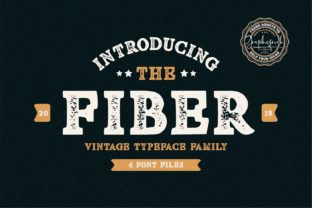
Fiber’s design draws from early 20th-century wood-type letterforms—think hand-carved signage, weathered barn advertisements, and bold circus posters. But it’s not a literal revival. Instead, the designers refined those raw, organic qualities into something crisp, consistent, and highly functional for modern use. Each uppercase letter features subtle irregularities: uneven stroke weights, gentle tapering, and soft, slightly asymmetrical serifs. Lowercase characters are less common in display use—but when included—they maintain visual harmony without sacrificing legibility at larger sizes.
The font’s high contrast between thick and thin strokes adds drama and presence. Yet unlike many ultra-bold display faces, Fiber avoids visual fatigue. Its generous x-height and open counters (the enclosed spaces inside letters like ‘a’, ‘e’, or ‘o’) ensure readability even when scaled down to 48–60pt for medium-sized signage or packaging.
Why Crafters and Small-Business Makers Reach for Fiber
Western-themed crafts thrive on authenticity—and authenticity isn’t about perfect replication. It’s about evoking feeling. A customer holding a hand-stamped denim tote bag doesn’t need to know the history of wood type to sense that the logo feels *earned*, not engineered. That’s where Fiber delivers.
- Leathercrafters use Fiber for embossed brand names on belts and wallets—its strong vertical stress mirrors traditional tooling lines.
- Small-batch brewers apply it to tap handles and can labels, pairing it with earthy color palettes and minimalist layouts to suggest heritage without pretense.
- Stationery designers layer Fiber over textured kraft paper backgrounds for wedding invitations themed around desert elopements or mountain cabins.
- Printmakers pair it with linocut illustrations—its structural clarity holds up beautifully beside hand-cut imagery.
Crucially, Fiber works because it’s designed for application, not just aesthetics. Kerning pairs are carefully tuned—not just for “AV” or “To”, but for real-world combinations like “TEXAS”, “RANCH”, or “SALOON”. That attention saves hours in manual spacing adjustments during production.
How Fiber Fits Into Modern Digital Workflows
Some vintage-inspired fonts falter in digital environments—poor hinting, missing OpenType features, or inconsistent metrics across weights. Fiber avoids those pitfalls. It ships with full Latin-1 support, standard ligatures, and stylistic alternates (like a swash capital “A” or a flourished “Q”) that activate automatically in apps supporting OpenType features—Adobe Illustrator, Affinity Designer, and even recent versions of Figma.
For web use, Fiber is available in WOFF2 format with variable width options—meaning you can adjust tracking dynamically depending on container width, rather than relying solely on CSS letter-spacing. That flexibility matters when your craft business site displays product thumbnails on mobile and hero banners on desktop.
And yes—it’s compatible with cutting machines. Whether you’re exporting vector paths for a Cricut or sending files to a laser engraver, Fiber’s clean outlines and minimal overlapping paths convert reliably. No unexpected gaps, no stray nodes. Just crisp, cut-ready shapes.
Pairing Fiber With Other Typefaces (Without Clashing)
A bold display font like Fiber doesn’t need company—but it often benefits from thoughtful companionship. The key is contrast without competition.
For body text or captions, choose a neutral, humanist sans-serif with similar x-height and modest stroke variation. Fonts like Inter, Work Sans, or Manrope provide breathing room while keeping the overall tone grounded and approachable. Avoid geometric sans-serifs (like Montserrat or Poppins) unless used sparingly—they can feel too clinical next to Fiber’s warmth.
If you want to deepen the vintage mood, try a modest serif—Lora or Cormorant Garamond—but only at smaller sizes and with generous line height. Never set paragraph text in Fiber itself. It’s a spotlight font, not a stagehand.
One underrated pairing? Fiber with handwritten script—but only if the script is restrained. Think ink-brush lettering with low contrast and steady rhythm, not flamboyant calligraphy. The contrast between Fiber’s structured boldness and a quiet script creates hierarchy and intimacy in equal measure.
Practical Considerations Before You Use Fiber
Like any strong personality, Fiber demands intention. Here’s what thoughtful users keep in mind:
- Scale matters. Fiber shines at 36pt and above. Below 24pt, its details blur and its impact flattens. If your project needs small-label legibility, use Fiber for the headline only—and pair it with a highly legible secondary face.
- Color contrast is non-negotiable. Its thick strokes absorb light. On dark backgrounds, avoid very light tints—go for creamy off-whites or warm beiges instead of stark #FFFFFF. On light backgrounds, rich charcoal (#333333) reads more authentically than pure black (#000000).
- Less is more with effects. Drop shadows, heavy outlines, or gradients can muddy Fiber’s craftsmanship. If you must add texture, try a subtle noise overlay or a faint paper grain beneath the text—not on top of it.
- Licensing is straightforward—but verify. Fiber is available under both desktop and web licenses. If you're selling physical goods (like printed posters or embroidered patches), standard desktop licensing covers it. For SaaS platforms or embedded digital products, check extended terms—but most craft-focused use cases fall under standard coverage.
Real Projects Where Fiber Made the Difference
A Colorado-based candle maker switched from a generic slab serif to Fiber for their “High Plains” scent line. Sales increased 22% in three months—not because the font changed the wax, but because shelf photography suddenly communicated place and tradition more clearly. Customers reported “feeling the wind” before even smelling the sage-and-cedar blend.
Another example: a Texas pottery studio used Fiber for their workshop sign and class schedule board. Local visitors began photographing the sign—not as decor, but as part of their experience. That organic visibility led to a 35% uptick in walk-in registrations.
These aren’t flukes. They reflect how deeply typography influences perception—especially in tactile, values-driven markets. When your audience chooses handmade over mass-produced, they’re choosing meaning. Fiber helps you deliver that meaning visibly, immediately, and respectfully.
Final Thought: Fiber Isn’t Just a Font—It’s a Design Decision With Weight
You could pick any bold, Western-adjacent font. But Fiber stands apart because it balances reverence with usability, character with clarity, and nostalgia with now. It doesn’t shout “old-timey”—it whispers “this was made with care.” And in a world saturated with algorithmic polish and AI-generated sameness, that whisper carries further than most shouts.
Whether you're sketching on tracing paper or fine-tuning kerning in Illustrator, using Fiber signals that you value intention over inertia—that every curve, every serif, every space between letters serves a purpose beyond decoration. That’s why so many makers return to it, season after season, project after project. Not as a trend, but as a trusted collaborator.