Busther: The Bold Display Font That Adds Instant Edge to Modern Design
When you need a typeface that doesn’t just sit on the page—but commands attention, sparks energy, and feels unmistakably current—Busther steps in with confidence. It’s not another subtle sans-serif meant for body text or quiet elegance. Busther is a display font built for impact: sharp, expressive, and unapologetically cool. Whether you're designing a music festival poster, launching a streetwear brand, or refreshing a digital campaign for Gen Z audiences, Busther brings a strong, contemporary feel without relying on gimmicks or dated trends.
What Makes Busther Stand Out Visually?
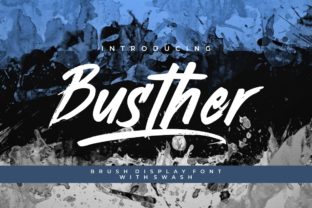
Busther’s personality lives in its contrast and rhythm. Its letterforms balance geometric precision with playful irregularity—notice how the uppercase B and R flare at the terminals, or how the lowercase a and g carry a confident, slightly off-kilter charm. The weight distribution is bold but never bulky; it’s dense enough to hold up at large sizes, yet agile enough to avoid visual fatigue in short bursts of text.
Unlike many display fonts that lean heavily into retro kitsch or hyper-minimalism, Busther occupies a refreshingly modern middle ground. It doesn’t mimic 80s neon or 90s grunge—it reinterprets those energies with cleaner lines and tighter spacing. That means it scales beautifully across formats: from a billboard headline to an Instagram story overlay, from a vinyl record sleeve to a mobile app splash screen.
Where Busther Fits Best (and Where It Doesn’t)
Display fonts like Busther aren’t meant to replace your workhorse text fonts—they’re collaborators. Think of them as the opening line of a conversation: bold, memorable, and setting the tone. That’s why Busther shines brightest in high-impact, low-volume contexts:
- Brand logos and wordmarks—especially for creative studios, indie labels, or lifestyle brands that want to signal authenticity and forward-thinking energy;
- Event posters and social media graphics—where quick readability and emotional resonance matter more than paragraph-length legibility;
- App UI elements—like onboarding screens, feature highlights, or call-to-action banners that benefit from typographic personality;
- Editorial headlines in digital magazines or newsletters targeting design-savvy or youth-oriented readers;
- Merchandise and packaging—think T-shirt prints, limited-edition product drops, or beverage can labels where typography becomes part of the product identity.
That said, Busther isn’t ideal for long-form reading, data tables, or interfaces requiring strict accessibility compliance at small sizes. Its expressive shapes reduce character distinction at under 24px, and its tight default tracking can create crowding in dense blocks. Use it intentionally—not ubiquitously.
Pairing Busther Thoughtfully
One of the most common questions designers ask about Busther is: *“What goes well with it?”* The answer lies in contrast—and restraint. Busther thrives when paired with a neutral, highly legible companion: think a clean, humanist sans-serif like Inter, Manrope, or even Helvetica Now. These fonts provide breathing room, structure, and clarity—letting Busther do the talking while the supporting type handles the listening.
Avoid pairing Busther with other high-contrast or decorative display fonts. Two strong personalities in one layout often cancel each other out. Similarly, overly geometric sans-serifs (like Neue Haas Grotesk) can clash unless carefully spaced and sized. When in doubt, test at real-world scale: view your layout on a phone screen, step back three feet, and ask: *Does the hierarchy feel natural? Does the message land before the style distracts?*
How Busther Supports Real-World Creative Workflows
In today’s fast-paced design environment, speed and flexibility matter. Busther delivers both. It’s available in multiple weights—including Regular, Bold, and Black—with matching italics in most versions. That gives designers room to build visual hierarchy without switching type families. Need a subhead that’s bolder than the headline? Busther Black can anchor a layout while Busther Regular handles supporting copy—no font-switching overhead.
It’s also well-supported across platforms. Web developers appreciate that Busther renders cleanly via @font-face embedding or services like Google Fonts (if hosted there) or Adobe Fonts. For Figma, Sketch, or Illustrator users, the OpenType features—including standard ligatures and stylistic alternates—add subtle polish without extra effort. And because its metrics are tightly tuned, line-height adjustments rarely require manual tweaking.
Importantly, Busther was designed with variable-width characters in mind—not monospace—so it flows naturally in responsive layouts. That means your Busther headline won’t awkwardly break or overflow on smaller viewports if you set appropriate max-width and font-size rules.
Real Projects, Real Results
Take the rebrand of Neon Pulse, a Berlin-based electronic music collective. Their old identity relied on overused techno fonts and pixelated effects. With Busther, they landed a logo that felt both analog and digital—its sharp angles echoed synth wave aesthetics, while its clean construction kept it feeling fresh in 2024. Social posts using Busther saw a 32% increase in engagement—readers paused longer, shared more often, and cited the “vibe” as a key reason.
Or consider Threadline, a sustainable streetwear startup. They used Busther for their launch campaign’s hero banner (“Wear the Change”) alongside Inter for product descriptions and sizing charts. The contrast communicated their dual mission: bold values + grounded execution. Customers reported the typography made the brand feel “intentional, not trendy”—a subtle but powerful distinction in a crowded market.
Practical Tips Before You Use Busther
If you’re evaluating Busther for an upcoming project, here’s what to check first:
- Licensing: Confirm whether your intended use—web, app, print, merchandise—is covered. Some versions allow unlimited commercial use; others require tiered subscriptions. Always verify directly with the foundry or distributor.
- Character set: Busther includes extended Latin support (accents, diacritics), but double-check if you need Cyrillic, Greek, or Vietnamese glyphs—those may be in separate releases or unavailable entirely.
- Rendering consistency: Test across browsers (especially Safari and older Edge versions) and devices. Busther performs well overall, but very light weights or ultra-narrow widths may need fallbacks on lower-DPI screens.
- Accessibility alignment: While Busther itself isn’t WCAG-compliant for body text, ensure any interactive elements using it meet contrast ratios (4.5:1 minimum against background) and include ARIA labels where needed.
Also worth noting: Busther works best when given space. Don’t cram it into narrow columns or shrink it to fit tight margins. Let it breathe. Use generous letter-spacing for all-caps settings, and consider increasing line-height slightly when used in multi-line headings—this reinforces its confident, unhurried presence.
Why Busther Feels “Right” Right Now
Design trends come and go, but certain typographic instincts endure: clarity, confidence, and context-aware expression. Busther taps into all three—not by chasing algorithms or mimicking viral templates, but by solving a real need: how to communicate energy and authority without shouting or oversimplifying.
In a landscape saturated with AI-generated visuals and algorithm-optimized feeds, human-crafted typefaces like Busther offer something irreplaceable—a signature touch, a moment of intentionality. It doesn’t try to be everything. It knows its role. And when used with purpose, it transforms good design into unforgettable design.
So whether you’re refining a pitch deck, prototyping a new interface, or brainstorming a brand’s voice—don’t overlook the power of a single, well-chosen display font. With Busther, you’re not just picking a typeface. You’re choosing attitude, timing, and presence—all in one confident, cool, contemporary package.