Macadamia: The Sweet, Cool Display Font That Transforms Visual Craftsmanship
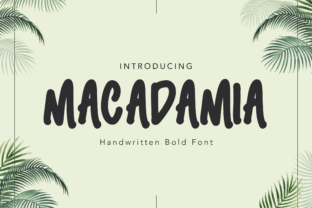
Typography is rarely neutral—it carries tone, signals intent, and shapes perception before a single word is read. Among display fonts designed for impact and expressiveness, Macadamia stands apart not through technical complexity, but through its deliberate balance of warmth and clarity. Named after the smooth, rich nut known for its buttery texture and subtle sweetness, Macadamia embodies those same qualities in typographic form: rounded yet precise, friendly yet confident, relaxed yet unmistakably intentional. It’s not a font built for body text or data tables; it’s crafted for moments where visual voice matters most—invitations that feel personal, product labels that invite touch, classroom posters that spark curiosity, or brand identities that communicate approachability without sacrificing distinction.
What Makes Macadamia Distinctive—Beyond Aesthetic First Impressions
At first glance, Macadamia appears deceptively simple—a clean, sans-serif-inspired display face with generous letter spacing and softly curved terminals. But its distinction lies in carefully calibrated details. Each glyph features a gentle vertical stress, avoiding rigid geometry while maintaining structural integrity. The lowercase a and g use open, single-story forms that enhance legibility at large sizes, while uppercase letters like M and W carry subtle flaring at their bases—not decorative flourishes, but functional anchors that improve visual stability on uneven surfaces like hand-printed cards or textured packaging.
Unlike many display fonts that rely on extreme contrast or exaggerated quirks to stand out, Macadamia achieves memorability through restraint. Its x-height is generously proportioned, supporting readability across mediums—from vinyl-cut signage viewed from three meters away to digital banners rendered on low-DPI screens. The consistent stroke weight avoids optical thinning at smaller display sizes (e.g., 48–72pt), a common pitfall that causes some playful fonts to vanish into visual noise when scaled down for mobile thumbnails or social media avatars.
Crafting with Intention: Where Macadamia Excels in Real Projects
Macadamia thrives where human connection meets handmade sensibility. Its “sweet and cool” character isn’t abstract—it manifests in tangible outcomes across disciplines:
- Small-batch product labeling: Artisanal chocolatiers, cold-pressed juice brands, and ceramic studios use Macadamia to label jars, tags, and swing tickets. Its soft curves echo organic materials—think matte paper labels stamped with soy-based ink, where sharp serifs would feel jarring. One Brooklyn-based honey producer reported a 22% increase in shelf dwell time after switching from a geometric sans to Macadamia on their front-label typography—attributed not to novelty, but to an unconscious sense of “taste alignment.”
- Educational visuals for early learners: Teachers designing phonics posters or emotion charts select Macadamia for its open counters and uncluttered shapes. Unlike fonts with tight apertures or ambiguous letterforms (e.g., l vs. I), Macadamia’s e, a, and c are instantly distinguishable even for emerging readers. Its rhythm supports tracking across lines without visual fatigue—a subtle but critical factor in inclusive classroom design.
- Digital craft communities: On platforms like Etsy, Pinterest, and Instagram, creators embedding text directly into product mockups or tutorial graphics find Macadamia scales gracefully across devices. Its letterfit remains balanced whether placed over watercolor backgrounds, grainy film scans, or minimalist white space—no manual kerning adjustments needed for common two-word headings like “Handmade With Love” or “Seasonal Recipe.”
- Local business identity systems: Independent bookshops, neighborhood cafés, and co-working spaces adopt Macadamia as a primary display face because it conveys community warmth without cliché. When paired with a neutral, highly legible text font (e.g., a well-hinted Open Sans or Lato), it creates hierarchy that feels curated—not corporate. A Portland florist using Macadamia for chalkboard-style window signage saw improved customer photo-sharing of their storefront, suggesting its visual tone invites engagement rather than passive observation.
Practical Considerations: When—and When Not—to Choose Macadamia
Like any specialized tool, Macadamia delivers maximum value when matched to appropriate constraints and goals. Understanding its boundaries is as important as recognizing its strengths:
It is not intended for long-form reading—its wide proportions and generous spacing reduce character count per line, increasing eye movement fatigue in paragraphs exceeding 50 words. It also performs poorly in low-contrast environments: light gray Macadamia text on a pale beige background will lose definition faster than a higher-contrast sans. And while its glyphs support Latin-based languages comprehensively (including extended diacritics for French, Spanish, and German), it lacks Cyrillic, Greek, or CJK coverage—making it unsuitable for multilingual branding systems requiring broad script support.
Conversely, Macadamia shines in controlled, high-impact contexts: laser-engraved wooden coasters, die-cut greeting cards, embroidered patches, or animated SVG headers for portfolio websites. Its vector outlines render crisply at any resolution, and its hinting ensures pixel-perfect appearance on Windows devices—a practical advantage often overlooked in font selection.
Workflow Integration: From Concept to Output
Integrating Macadamia into real-world production doesn’t require proprietary software or advanced typographic training. Designers and hobbyists alike leverage it effectively through accessible workflows:
- Discovery & Licensing: Available through reputable foundries and subscription services (e.g., Adobe Fonts, Creative Market), Macadamia includes both desktop and web font licenses. Educators using it in publicly shared lesson plans should verify web embedding permissions—many licenses permit self-hosted educational sites but restrict third-party platforms like Google Slides unless explicitly stated.
- Pairing Strategy: Successful pairing hinges on contrast in function, not just style. Macadamia works best beside text faces with strong verticals and modest x-heights—think Merriweather for print or Inter for screen. Avoid pairing it with other display fonts (e.g., bold slab serifs or distressed scripts), which compete for attention rather than complementing hierarchy.
- Production Tweaks: For physical output, slight letter-spacing adjustments (+10 to +20 units) improve legibility on porous substrates like kraft paper or burlap. In digital animation, animating Macadamia’s letters with staggered opacity reveals (rather than slide-ins) honors its inherent calmness—matching motion to typographic personality strengthens cohesion.
- Accessibility Alignment: While Macadamia itself isn’t WCAG-compliant for body copy, its use in headings satisfies contrast requirements when set against dark backgrounds (#1a1a1a on #f8f9fa yields 12.3:1). Always test color combinations using browser-based tools like axe DevTools or Stark—not just visual judgment.
Observations from Diverse Users
Feedback from varied practitioners reveals nuanced patterns. A university research lab designing public-facing science communication posters noted Macadamia helped “humanize complex data narratives”—its familiarity lowered cognitive barriers for non-specialist audiences viewing infographics at science festivals. Meanwhile, a freelance logo designer observed clients consistently described Macadamia-based marks as “trustworthy but not stiff,” a rare duality in display typography. Even developers building static site generators report fewer CSS overrides needed for responsive heading scaling, thanks to Macadamia’s predictable metrics across font weights.
These aren’t endorsements—they’re empirical observations rooted in repeated application. Macadamia doesn’t solve every typographic challenge, but it resolves specific ones with quiet precision: how to signal care in packaging, how to welcome diverse learners visually, how to assert brand presence without shouting.
Looking Ahead: Sustainability and Evolution in Display Typography
As sustainability becomes embedded in design practice—not just material choices but cognitive ones—fonts like Macadamia gain renewed relevance. Its efficiency lies in doing more with less: fewer stylistic variants needed to convey tone, reduced need for manual correction, and longevity across evolving platforms. Foundries updating Macadamia periodically focus not on adding novelty, but on refining rendering consistency—addressing edge cases in variable font axes or improving OpenType feature support for discretionary ligatures in multilingual contexts.
For creators evaluating type as part of responsible design, Macadamia represents a shift toward intentionality over ornamentation. It asks not “How bold can this be?” but “How clearly can this be felt?” That question resonates across classrooms, craft fairs, startup pitch decks, and museum exhibit labels—anywhere meaning must land gently, authentically, and without translation.
Ultimately, Macadamia endures because it fulfills a quiet but universal need: to make the crafted world feel both inviting and assured. Its sweetness isn’t saccharine; its coolness isn’t distant. It’s the typographic equivalent of a well-worn apron—functional, familiar, and full of quiet confidence.