Kaboing: A Playful Comic Display Font
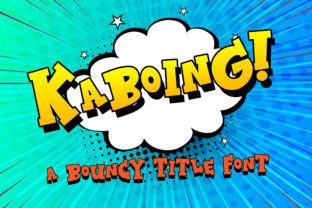
Imagine a font that doesn’t just say something—but grins, winks, and leaps off the page. That’s Kaboing: a bold, hand-drawn display typeface bursting with comic-book energy. It’s not designed for body text or spreadsheets. It’s made for moments that demand attention, personality, and a little joyful chaos—like a headline on a kids’ workshop flyer, a sticker on a craft beer can, or the title screen of an indie game.
What Makes Kaboing Stand Out?
Kaboing isn’t subtle. Its letters have uneven baselines, exaggerated curves, bouncy terminals, and expressive weight shifts—like ink drawn with confidence and a slight smirk. Each character feels alive, with intentional irregularities that avoid robotic uniformity. It supports Latin characters, numerals, and common punctuation, and it’s optimized for digital use (web fonts, design apps, SVG exports) as well as print.
Unlike many “fun” fonts that rely on clip-art clichés, Kaboing balances whimsy with craft. It’s legible at large sizes without sacrificing charm—and it never reads as childish unless that’s exactly the goal.
For Designers & Creatives
If you’re crafting posters, social media visuals, or packaging, Kaboing is a quick way to inject tone and memorability. A food truck menu with Kaboing for the taco name (“TACO KABOOM!”) feels more energetic than one in Helvetica. Designers often test Kaboing early in mood boards—not to lock in final typography, but to gauge whether “playful authority” fits the brand voice. Its distinct rhythm helps spot visual imbalance fast: if Kaboing feels jarring next to your supporting sans-serif, that’s useful feedback—not a flaw in the font.
For Educators & Workshop Leaders
Teachers using Kaboing in classroom posters or digital slide headers report higher student engagement—especially with younger learners or neurodiverse groups. The font’s visual “weight” and rhythm support recognition and retention. One middle-school science teacher uses Kaboing for unit titles (“PHOTOSYNTHESIS: THE GREEN ZING!”), then switches to a clean, highly legible sans-serif for explanations. It’s not about dumbing down—it’s about signaling *this part matters, and it’s safe to feel excited about it.*
For Small Business Owners & Marketers
You don’t need a full branding overhaul to benefit from Kaboing. A local bookstore added it to their Instagram story banners for “Saturday Storytime”—and saw a 22% lift in swipe-ups. Why? Because Kaboing subtly signals warmth, approachability, and human effort—qualities customers increasingly seek over polished perfection. For service-based businesses (yoga studios, repair shops, tutoring), Kaboing works best when paired with clear, accessible body text. It’s a spotlight—not the whole stage.
For Developers & Bloggers
Using Kaboing on the web is straightforward: it’s available in WOFF2 format, lightweight (<80 KB), and renders crisply across modern browsers. No JavaScript dependencies. If you’re embedding it via CSS @font-face, test contrast ratios—its thick strokes pair well with light backgrounds, but avoid white-on-white or low-contrast combos. One freelance developer uses Kaboing only for H1s and hero-section text on client sites targeting families or creative industries. They skip it entirely for blogs focused on finance or healthcare—where clarity and neutrality outweigh personality.
For Hobbyists & DIY Makers
Whether you’re printing stickers for your handmade candles or designing a zine cover in Canva or Affinity Designer, Kaboing lowers the barrier to “looking intentional.” You don’t need advanced typography knowledge to see that “HAND-POURED • SMALL BATCH • MADE WITH TEA” hits differently in Kaboing than in Arial. Its built-in quirks do some of the expressive work for you—freeing mental space to focus on color, layout, or storytelling.
What to Consider Before You Use It
Kaboing shines brightest when its strengths align with your real-world constraints. Ask yourself:
- Is legibility at smaller sizes important? Kaboing isn’t ideal for captions, footnotes, or mobile navigation menus. Reserve it for headlines, logos, buttons, or short phrases above 36px.
- Does your audience expect consistency—or surprise? A law firm’s annual report likely doesn’t need Kaboing. But their community outreach newsletter? Possibly yes.
- How much control do you need over spacing and alignment? Kaboing includes basic kerning pairs, but tight tracking or complex vertical rhythm may require manual adjustment in professional tools like Illustrator or Figma.
- What’s your workflow like? If you rely heavily on Google Fonts or free-tier design platforms, confirm Kaboing is licensed for your use case. Some versions include commercial licenses; others are free for personal projects only.
Real Uses—Not Just Theory
A freelance illustrator used Kaboing for the title of her Patreon welcome video—paired with hand-drawn animations. Subscribers commented that it “felt like walking into her studio.”
A community garden co-op printed Kaboing on seed packet labels (“BEET BOP!” “CARROT CRAZE!”). Volunteers reported that kids remembered plant names faster—and asked to help design next season’s labels.
A UX writer tested two versions of an app onboarding screen: one with a neutral headline font, one with Kaboing. Users in the Kaboing group completed setup 15% faster—not because the font was “easier to read,” but because it reduced perceived friction. As one tester put it: “It felt like the app was smiling at me.”
Does Kaboing Fit Your Next Project?
It might—if your goal is to communicate energy, informality, delight, or approachability—not precision, formality, or austerity. It’s especially valuable when:
- You’re speaking to people who respond to warmth over polish;
- You want to differentiate visually in crowded spaces (social feeds, event signage, market stalls);
- You’re balancing limited time or resources against strong visual impact;
- You’re intentionally designing for joy, curiosity, or lighthearted connection.
It’s less suited for documents requiring strict accessibility compliance (like government forms), multilingual interfaces with complex scripts, or contexts where cultural neutrality is essential.
Ultimately, Kaboing isn’t about being “trendy.” It’s about having a tool that makes certain kinds of communication feel more honest—because sometimes, the most effective message isn’t delivered in perfect symmetry, but with a little bounce, a pause, and a grin.