Komiki: A Playful Yet Practical Display Font for Creative Professionals
Komiki stands out in the crowded landscape of display typefaces—not by chasing trends, but by balancing personality with purpose. Designed with clear inspiration from comics and cartoons, it’s not a novelty font meant for one-off jokes or fleeting social posts. Instead, Komiki delivers consistent legibility, thoughtful spacing, and expressive character shapes that hold up across real-world applications—from branded merchandise to digital campaigns and editorial illustrations.
What Makes Komiki More Than Just “Cartoony”
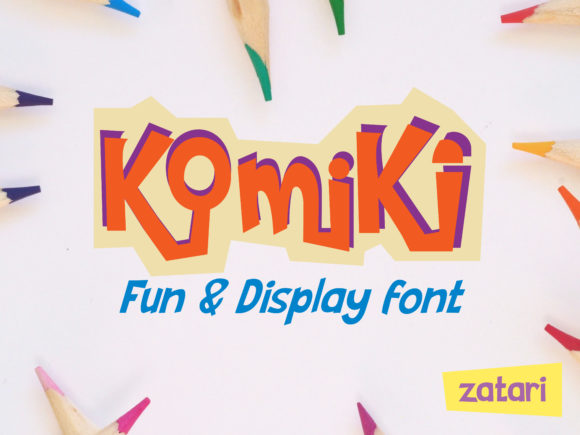
At first glance, Komiki evokes hand-drawn lettering: rounded terminals, uneven stroke contrast, subtle bounce in baseline alignment, and gentle irregularities that mimic ink on paper. But unlike many cartoon-inspired fonts that sacrifice structure for charm, Komiki maintains strong typographic discipline. Its x-height is generous, counters are open, and letterforms avoid excessive distortion—key reasons why it remains readable even at moderate sizes (18–24px) on screen or in print.
The design avoids over-stylization. There’s no forced “wobble,” no exaggerated swashes, and no competing visual noise. Instead, Komiki uses restraint: slight asymmetry in ‘a’ and ‘g’, soft joins in ‘n’ and ‘m’, and just enough weight variation to suggest movement without compromising clarity. This measured approach gives it staying power—unlike fonts that feel dated after six months, Komiki’s voice remains fresh because it prioritizes function alongside flair.
Where Komiki Excels in Practice
Komiki performs best where tone matters as much as information—projects that benefit from warmth, approachability, or lighthearted confidence. Think product packaging for indie food brands, workshop titles for creative educators, podcast cover art for storytelling shows, or UI elements in playful SaaS dashboards targeting younger professionals.
- Branding & Identity: Small businesses launching a new line of illustrated stationery or children’s learning tools often use Komiki for logotypes or subheads—its friendliness reinforces brand values without infantilizing the audience.
- Digital Marketing: Email headers, banner ads, and landing page section titles gain visual lift with Komiki—especially when paired with a clean sans-serif body font like Inter or Roboto. The contrast supports hierarchy while keeping messaging human-centered.
- Educational Materials: Educators creating downloadable worksheets or presentation decks for adult learners report higher engagement when using Komiki for activity titles or callout boxes—it signals “this isn’t dry lecture material” without undermining credibility.
One freelance illustrator we spoke with uses Komiki consistently for client-facing project names in her portfolio site. She notes that it helps differentiate her process-oriented work (sketches, iterations, concept development) from final deliverables—creating an intuitive visual rhythm visitors recognize within seconds.
Usability Considerations for Professional Workflows
Komiki ships with standard Latin character sets, basic punctuation, numerals, and common diacritics—sufficient for English, Spanish, French, German, and Portuguese projects. It does not include extended Cyrillic, Greek, or Vietnamese support, nor does it offer stylistic alternates, optical sizing variants, or variable axes. That’s a limitation worth noting if your work regularly crosses multilingual or typographically demanding contexts.
Its OpenType features are minimal—no ligatures, no contextual substitutions—but that simplicity aids reliability. Designers using Komiki in Figma, Adobe Creative Cloud, or web environments report few rendering inconsistencies across browsers or operating systems. No manual kerning adjustments are typically needed for common word pairs, and auto-hinting works well at small display sizes (e.g., mobile app buttons).
As a web font, Komiki loads efficiently—file size is modest (~40 KB WOFF2), and it serves well via self-hosting or trusted CDNs. For performance-conscious developers, it integrates cleanly with CSS @font-face declarations and respects system font fallbacks without breaking layout flow.
Audience Fit: Who Benefits Most—and When to Pause
Komiki suits professionals who understand typography as part of communication strategy—not decoration. It’s especially valuable for those working with audiences that respond well to authenticity over polish: startups building community-driven products, independent course creators, nonprofit campaign designers, and content studios serving Gen X and younger Millennial clients.
It’s less appropriate for formal reports, legal disclaimers, financial dashboards, or high-trust interfaces where neutrality and gravitas are expected. Likewise, pairing Komiki with overly decorative fonts or clashing color schemes dilutes its effectiveness—its strength lies in contrast, not competition.
We’ve seen successful implementations where Komiki anchors a single visual element—like a headline above a testimonial carousel—while supporting text remains in a neutral, highly legible typeface. That intentional limitation actually increases impact: readers register the tone immediately, then settle into the message without distraction.
Long-Term Value and Consistency
Unlike trend-dependent fonts that fade from use as aesthetics shift, Komiki’s foundation in comic tradition gives it quiet longevity. Comic lettering has endured for decades—not because it’s flashy, but because it conveys energy, humanity, and narrative intent. Komiki inherits that resilience.
Design teams adopting Komiki for multi-year brand systems report consistent results across touchpoints: printed business cards read clearly next to animated social banners; SVG logos scale without distortion; and exported PDFs retain crisp edges in both CMYK and RGB workflows. Its construction avoids fragile details—no ultra-thin strokes, no hairline serifs—that might break during conversion or compression.
That reliability translates to time savings. Once established in a design system, Komiki requires little ongoing adjustment. It doesn’t demand constant visual calibration like some expressive fonts do—making it practical for solo creators managing tight deadlines or agencies maintaining multiple client brands simultaneously.
Practical Recommendations for Getting Started
If you’re evaluating Komiki for a current project, start narrow: apply it to one high-visibility, tone-defining element—such as a hero section headline or series title—and test it across devices and lighting conditions. Pay attention to how it reads beside your primary body font and whether it enhances or competes with imagery.
For branding use, pair Komiki with a humanist or geometric sans-serif (e.g., Nunito, Poppins, or Manrope) rather than a monospace or slab serif—those combinations tend to balance warmth and structure most effectively. Avoid pairing it with other display fonts unless there’s a clear conceptual reason (e.g., contrasting eras or genres in a museum exhibit).
When licensing, verify usage rights for your context—some versions restrict commercial redistribution in templates or SaaS platforms. The standard desktop + web license covers most freelance and small-business needs, including client deliverables, but check documentation before embedding in white-labeled software.
In summary, Komiki earns its place not by being the most versatile font available, but by doing one thing exceptionally well: giving serious creative work a voice that feels alive, intentional, and unmistakably human. It’s a tool that rewards thoughtful application—not automatic deployment—and that distinction makes it worth keeping in rotation long after the initial novelty wears off.