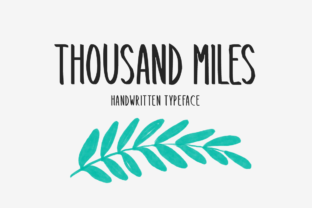
Thousand Miles Font
Thousand Miles is a handwritten typeface designed to evoke warmth, approachability, and quiet confidence. It features flowing, natural letterforms with subtle variation in stroke weight and rhythm—characteristics that reflect organic pen-on-paper movement rather than mechanical precision. Unlike script fonts that prioritize ornate flourishes or tight connectivity, Thousand Miles balances legibility with personality, making it suitable for contexts where authenticity matters but readability remains essential.
Why Designers and Content Creators Consider Thousand Miles
Designers often explore Thousand Miles when seeking a typeface that conveys sincerity without sacrificing clarity. Its casual charm supports branding efforts for lifestyle businesses, independent creators, editorial features, or product packaging where tone and voice are as important as visual hierarchy. Educators, writers, and small-business owners may also evaluate Thousand Miles for presentations, social media graphics, or printed materials where a human touch reinforces message intent.
Key Benefits of Using Thousand Miles
- Distinctive voice: It stands apart from overused sans-serif and generic script fonts, helping projects avoid visual homogeneity.
- Moderate legibility at medium sizes: While not intended for dense body text, Thousand Miles performs well in headings, quotes, logos, and short display settings—especially above 24px.
- Low technical barrier: Available in standard OpenType format, it supports common Latin character sets and integrates smoothly into most design tools and web environments via @font-face or font hosting services.
- Emotional resonance: Its relaxed structure suggests openness and thoughtfulness—qualities useful in wellness, education, or community-focused initiatives.
Tradeoffs and Practical Considerations
Thousand Miles is not optimized for extended reading. Its connected strokes and variable spacing reduce scan efficiency in long paragraphs or data-dense layouts. Users should expect limited language support: while it covers basic Western European characters, diacritics beyond common accented letters (e.g., ě, ñ, ø) may be missing or inconsistently rendered. Kerning pairs are tuned for English word shapes, so performance in other languages—particularly those with frequent ligatures or non-Latin scripts—may vary.
Web use introduces additional considerations. Because Thousand Miles is a display font, loading it as a web font adds file weight and may impact page speed if not optimized. Hosting the font locally and subsetting glyphs to include only required characters can mitigate this. Also, fallback behavior must be planned: pairing it with a neutral sans-serif (e.g., Inter or system-ui) ensures typographic continuity if Thousand Miles fails to load.
When Thousand Miles Is a Strong Fit
Thousand Miles works best in focused, intentional applications. It excels in logo design for boutique studios, artisanal brands, or personal portfolios where the name or tagline benefits from expressive typography. It’s effective in editorial design—for pull quotes, chapter titles, or cover lines—where contrast with a sturdy text face enhances visual pacing. Social media creatives use it selectively in quote cards or announcement banners, particularly when targeting audiences responsive to handmade aesthetics.
It also suits print applications like greeting cards, wedding stationery, or limited-run zines—contexts where physical texture, ink bleed, and tactile quality complement the font’s inherent informality. In these cases, its slight irregularity reads as craftsmanship, not inconsistency.
When to Explore Alternatives
Thousand Miles may fall short in scenarios demanding high functional clarity. For example, user interfaces, dashboards, instructional diagrams, or multilingual websites benefit more from highly legible, engineered typefaces like Roboto, Lato, or IBM Plex Sans. Similarly, brands prioritizing neutrality, authority, or global scalability may find Thousand Miles too stylistically specific—or potentially difficult to scale across diverse media (e.g., signage, embroidery, or low-resolution screens).
If a project requires extensive typographic hierarchy—including captions, footnotes, or tables—pairing Thousand Miles with a robust text companion becomes necessary. But if the goal is consistent voice across all typographic roles, a versatile family like Playfair Display + Lora or IBM Plex Serif + Sans offers tighter integration and broader language coverage without switching between unrelated designs.
Decision-Making Insights for Practical Use
Evaluating Thousand Miles begins with clarifying your primary use case. Ask: Is this font supporting a short, high-impact message—or carrying structural weight across many content types? If the answer is the former, Thousand Miles likely meets the need. If the latter, assess whether its stylistic strengths outweigh limitations in versatility.
Test it early in real contexts—not just mockups. Render sample text at actual sizes and on target devices. Check contrast against background colors using WCAG guidelines; some handwritten fonts struggle with accessibility compliance at smaller sizes or low-contrast combinations. Preview how it behaves alongside your secondary typeface: does spacing feel balanced? Does alignment remain stable across line breaks?
Also consider licensing. Thousand Miles is typically offered under desktop and web licenses, but usage rights vary by vendor. Some licenses restrict use in templates sold to third parties or embedded apps. Review terms before committing to large-scale deployment.
Final Thoughts on Alignment With Goals
Thousand Miles is a deliberate choice—not a default. It communicates intentionality: the decision to favor expressiveness over universality, warmth over formality, and craft over convenience. That makes it valuable for projects where differentiation and emotional connection are strategic priorities. However, its value diminishes when flexibility, scalability, or broad accessibility are central requirements.
Before selecting Thousand Miles, compare it against similar options—not just in appearance, but in supported characters, language coverage, and documented performance in real-world conditions. Look at how designers have used it successfully in published work, and note where adjustments (like manual kerning or custom spacing) were applied. That kind of contextual research reveals more about fit than any preview image alone.
In summary, Thousand Miles earns its place when authenticity amplifies purpose—and when its constraints align with your project’s scope, audience, and delivery environment.