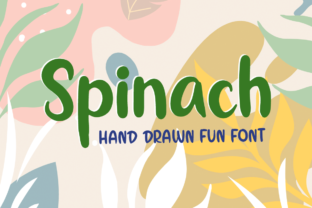
Spinach: A Friendly Display Font for Standout Design Projects
Spinach is a display typeface designed with bold personality and high visual impact. It falls into the “funky” or “playful” category of display fonts—characterized by exaggerated proportions, irregular curves, and expressive letterforms—but distinguishes itself through an unusually warm, approachable tone. Unlike many display fonts that lean heavily into irony, abstraction, or retro pastiche, Spinach maintains legibility at moderate sizes while inviting attention through its gentle eccentricity.
Designers often seek display fonts like Spinach when they need to establish strong visual hierarchy, convey brand warmth or creativity, or differentiate a headline, logo lockup, or promotional banner from surrounding text. Its friendly feel makes it especially relevant for projects targeting younger audiences, educational platforms, lifestyle brands, or community-oriented initiatives where approachability matters as much as visibility.
Why Consider Spinach?
Several practical factors make Spinach worth evaluating during font selection:
- Distinctive yet readable: At sizes above 36pt, Spinach holds up well in headlines and short phrases. Its open counters and consistent stroke modulation support recognition—even with unconventional shapes.
- Personality without pretension: It avoids the sharp edges or aggressive angles common in many modern display fonts, opting instead for soft terminals and subtle asymmetry. This supports messaging around inclusivity, care, or lighthearted authenticity.
- Strong typographic contrast potential: When paired with neutral sans serifs (e.g., Inter, Lato, or Roboto) or even restrained serifs (e.g., Merriweather), Spinach creates clear visual separation between heading and body text—helping guide readers naturally.
- Web-friendly availability: Spinach is available through major font hosting services and supports standard web formats (WOFF2), making implementation straightforward for responsive sites and digital campaigns.
Key Considerations Before Choosing Spinach
While Spinach offers notable strengths, it also comes with constraints typical of expressive display fonts. Understanding these helps avoid mismatched usage:
Legibility limits: Spinach is not intended for extended reading. Its decorative features reduce clarity below ~24pt, particularly in lowercase settings or dense paragraph contexts. Using it for body copy, captions, or interface labels risks accessibility issues and user fatigue.
Character set coverage: The font includes Latin-based glyphs and common punctuation but lacks extensive multilingual support (e.g., Cyrillic, Greek, or extended diacritics). Projects requiring broad language coverage may need supplemental typefaces or fallback strategies.
Tone alignment: Because Spinach conveys friendliness and informality, it may feel incongruous in contexts demanding authority, formality, or technical precision—such as legal documents, financial dashboards, or academic publications. Mismatched tone can unintentionally undermine credibility.
Weight and style options: Spinach currently offers limited stylistic variation—typically one primary weight with optional italics. Designers needing fine-grained typographic control (e.g., multiple weights for nuanced hierarchy or condensed variants for tight spaces) may find its range restrictive compared to expansive families like Montserrat or Poppins.
When Spinach Fits Well
Spinach works best in scenarios where its expressive qualities serve functional goals—not just aesthetic ones. Strong fits include:
- Branding for creative or community-driven organizations, such as independent bookshops, local food co-ops, or youth arts programs—where warmth and distinctiveness reinforce mission and values.
- Digital marketing assets like email headers, social media banners, or landing page hero sections—especially when paired with concise, action-oriented copy.
- Editorial design elements such as section dividers, pull quotes, or illustrated chapter openers—where brief, high-impact text benefits from personality without sacrificing scannability.
- Print materials with intentional contrast, like event posters or zines, where Spinach anchors visual interest and invites closer engagement.
When to Explore Alternatives
Spinach may be less suitable—and alternatives more practical—in several situations:
If your project requires scalable hierarchy across multiple sizes, consider fonts with broader weight ranges (e.g., Inter or Source Sans Pro) that maintain consistency from headings down to footnotes.
If accessibility compliance is a priority—particularly for users relying on screen readers or low-vision accommodations—prioritize fonts with tested readability metrics and robust OpenType features (e.g., Sans Forgetica for emphasis, or Dyslexie for learning contexts).
If you need multilingual or technical character support, evaluate fonts like Noto Sans or IBM Plex, which offer wide language coverage and structured design systems.
If brand neutrality or timelessness outweighs expressive flair—such as in enterprise software interfaces or institutional reports—more restrained options like Roboto or Work Sans provide flexibility without stylistic commitment.
Making an Informed Choice
Selecting a display font like Spinach should begin with clear questions about purpose, audience, and context—not just visual preference. Ask yourself:
- What role does this text play? Is it meant to attract, clarify, persuade, or identify?
- Who will encounter it—and under what conditions? (e.g., mobile screens, low bandwidth, ambient lighting)
- How much typographic flexibility do I need across devices, languages, or content types?
- Does Spinach reinforce—or distract from—the message’s core intent?
Testing is essential. Try rendering key phrases in Spinach alongside your chosen body font at actual intended sizes and backgrounds. Check contrast ratios using tools like WebAIM’s Contrast Checker. Preview how it appears in dark mode, on older devices, and with system font scaling enabled.
Remember: no font is universally “better.” Spinach excels when its friendly, standout qualities align with deliberate design strategy—not when applied as a default or trend-driven choice. Its value emerges most clearly when used selectively, intentionally, and in service of real communication goals.
For designers weighing expressive typography options, Spinach offers a compelling middle ground: distinctive enough to capture attention, yet grounded enough to support meaning. Evaluating it alongside project requirements—not just aesthetics—helps ensure it contributes to clarity and connection, rather than visual noise.